How often do you sit back and reflect on the amazing ability you have to read?
I mean, really sit down and consider the brain networks you established, most likely early on in your life, to allow for you to look at arbitrary symbols and to make meaning with them? To learn something new, go on an imaginary adventure, experience information being passed on to you from generations ago, all from strangely shaped forms on a page or screen? To read and process my words right this moment as your eyes pass over them?
As a literate individual, you are fortunate to have the ability to not only read, but comprehend what you are reading, and then use that information to meet your needs, your family’s needs, or to impact society as a whole, maybe even writing your own text depending on how you use your literacy skills.
Now, why—in this day and age—do I say fortunate related to your ability to read?
Let me answer that question by sharing a few statistics:
According to the Nation’s 2024 Report Card which is based on a literacy assessment also known as the National Assessment of Educational Progress (NAEP), 40% of fourth graders and about a third of eighth graders in the US are failing to meet the basic level of proficiency in reading. Further, 29% of American fourth graders are at the basic level with only 23% meeting proficiency and 8% considered advanced. The numbers don’t look much better for American 8th graders either, and this trajectory has been the case for decades.
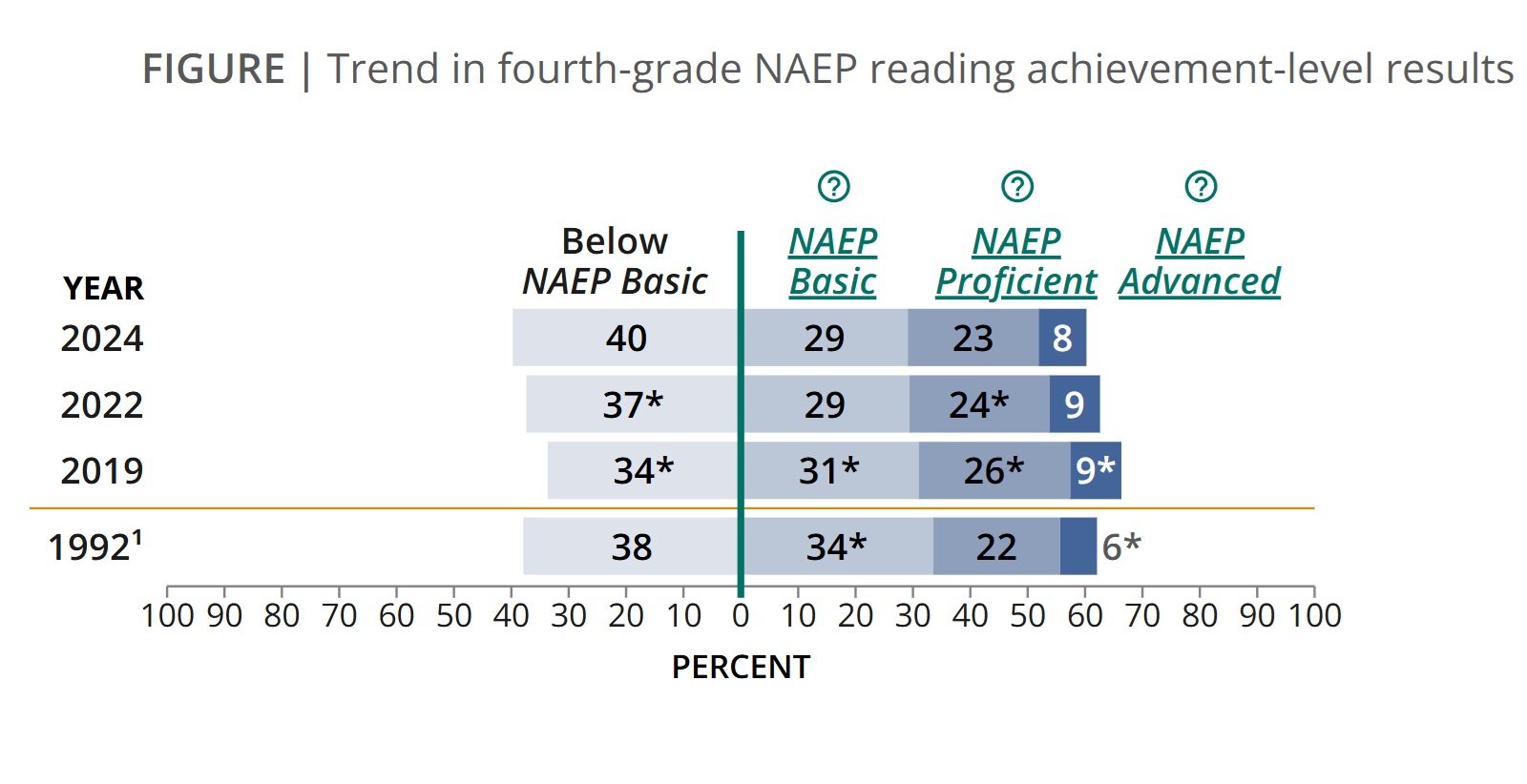
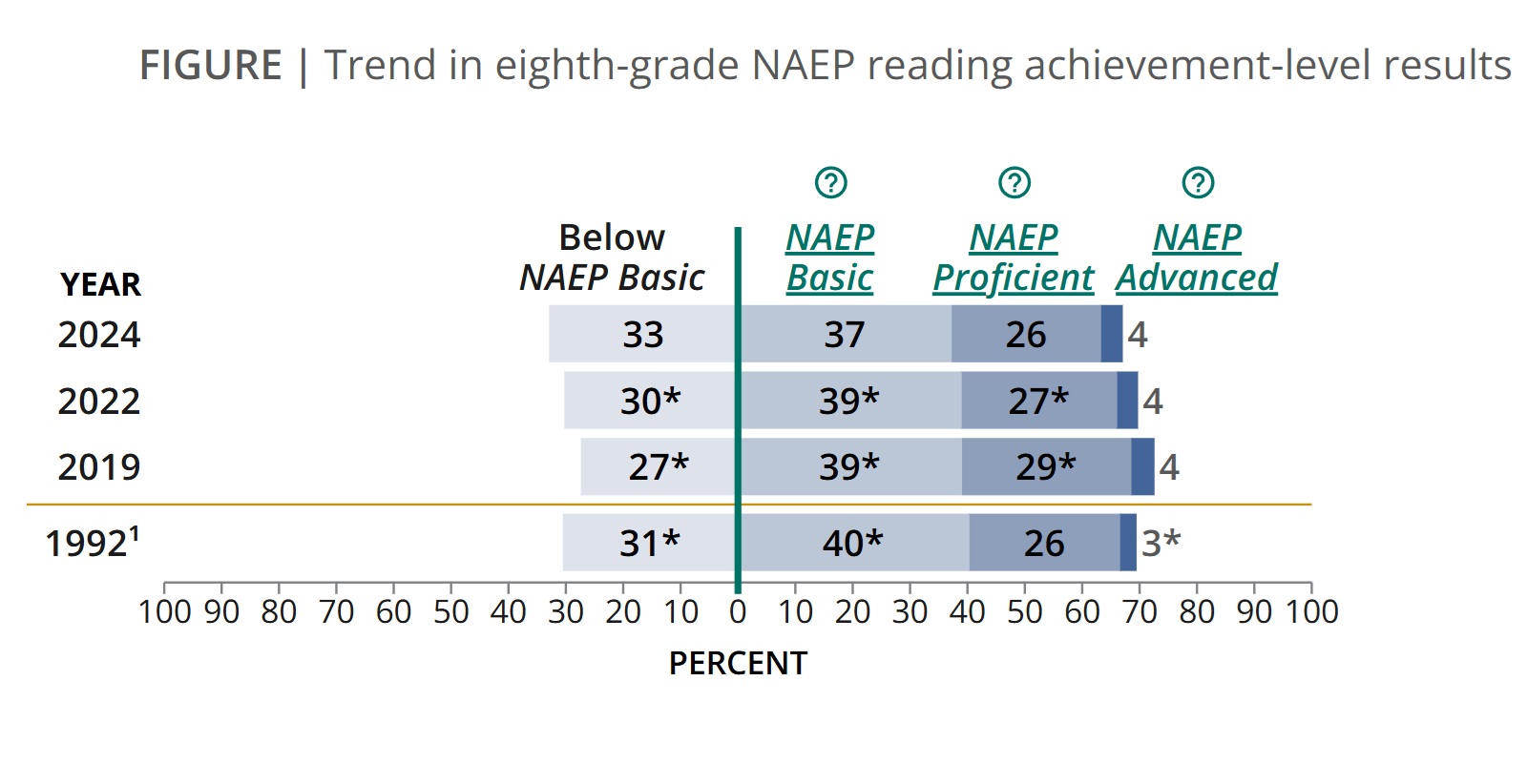 So that means, in 2024, if you lined up a group of American fourth grade students, about seven of every ten of those kids are at the basic level of reading, or below, for their grade meaning they have only partially mastered the skills needed to be considered proficient fourth grade readers; and the same goes for eighth graders. As you see in the descriptions below of what constitutes NAEP’s basic skills for fourth and eighth graders, the data suggests that an astounding number of our children barely grasp what can be considered very rudimentary reading skills.
(https://nces.ed.gov/nationsreportcard/reading/achieve.aspx)
And how about American adults and literacy rates? How are our adults faring in relation to reading skills?
According to the Program for the International Assessment of Adult Competencies (PIACC)—a large-scale study assessing the adult populations’ literacy, numeracy, and adaptive problem-solving skills—the data for the United States indicates that between 2017 and 2023, the literacy skills for US adults (aged 16-65) decreased. Specifically, there were increases in the number of adults performing at the lowest level of proficiency in literacy from 19% in 2017 to 28% in 2023 https://nces.ed.gov/surveys/piaac/2023/national_results.asp). Further, “adults classified as below level 1 may be considered functionally illiterate in English i.e. unable to successfully determine the meaning of sentences, read relatively short texts to locate a single piece of information, or complete simple forms” (OECD 2013). (Also, see PIACC literacy levels here: https://nces.ed.gov/surveys/piaac/measure.asp).
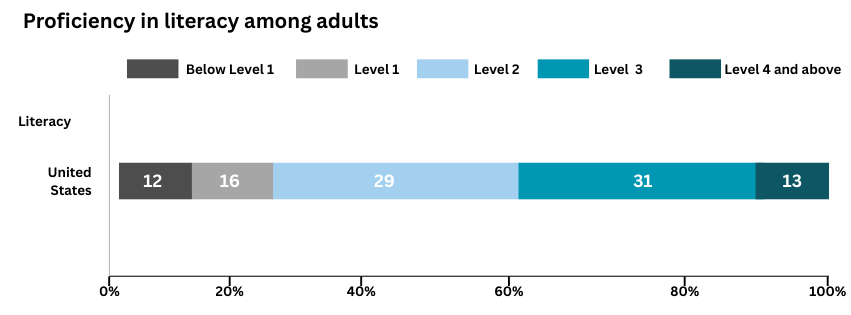
(Adapted from Figure 2. Proficiency in literacy, numeracy, and adaptive problem solving among adults: https://www.oecd.org/en/publications/survey-of-adults-skills-2023-country-notes_ab4f6b8c-en/united-states_427d6aac-en.html)
This indicates that almost a third of American adults are illiterate or close to it. Unfortunately, this isn’t surprising considering the aforementioned trajectory of a large number of American children only developing basic reading skills; it only makes sense that this would lead to a large number of American adults who continue to struggle with reading.
Do these statistics hurt your heart as much as they hurt mine?
I think about the relationship I have developed with literacy. How happy I feel diving into a good book and going on an amazing journey where I’m cheering the characters on. Or, jotting down notes as I read informational text with new knowledge that enriches my life or allows me to teach others.
Or, my ability to write down my own stories and then read them to eager listeners with the hope of cultivating a life-long love of reading—an affinity for reading that I didn’t develop myself until college.
I cannot imagine what life would be like for me if I never developed proficient reading skills, and how much different things would be for me now.
But, statistics like these make me want to double-down on my message of the importance of sharing literacy with children, starting at a very early age!
I believe that this cultivation for a love of literacy begins early in life and it is steeped in warm, loving interactions around language and literacy during childhood. I also believe it is our job as parents, teachers, concerned adults to begin reevaluating the messages we share about literacy, work to model our own use of literacy skills, and consider how we can begin building positive experiences with reading, writing, and spelling for ourselves and our children!
I say: BEGIN WITH PLAY!
So…I should probably confess something: I am an early childhood educator at heart. My degrees are in Psychology and Applied Developmental Psychology (BA from UCLA), Child Development (MA from California State University, Sacramento) and Education (PhD from UC Davis)— disciplines that center on the importance of play. Additionally, I have held many positions working with or adjacent to young children ranging from a toddler and preschool teacher, summer camp counselor and coordinator, after school program coordinator and trainer, and curriculum developer to Early Childhood Education and Child Development professor, children’s author, and professional speaker. Based on my studies and various experiences, I often go back to the importance of play!
Play sparks creativity. It allows us to take on characters and try new things. It gives young children a chance to use their bodies and current understandings to comprehend the world and build new brain networks. And boy, is it fun! Thus, why not find ways to combine play with the early and essential skills needed to begin building the literate brain?
Here’s my call to action for you: In what ways can you infuse play into your language and literacy experiences with children, starting from birth? How can you get the young learners in your life excited about story and words and writing, ultimately setting the stage for fun and play and positive associations related to those experiences?
I’ll share three ideas of ways you can infuse fun into your language and literacy experiences with any child in your life, starting today!!!
- Keep, keep on talking: It is clear that bathing the brain in language helps to set and strengthen foundational networks that literacy skills are built on. Talking, listening, engaging in conversation—these are key! Talk about your day, the things you see in the moment, the crazy dream you had. Ask them to share what they learned today, their favorite part of the movie you all just watched, what they see around them as you are on your family walk through the park. Make up silly rhymes or jokes or songs. Play with the sounds of words. Just talk—and be playful while you do it! This applies when engaging preverbal infants and toddlers as well!
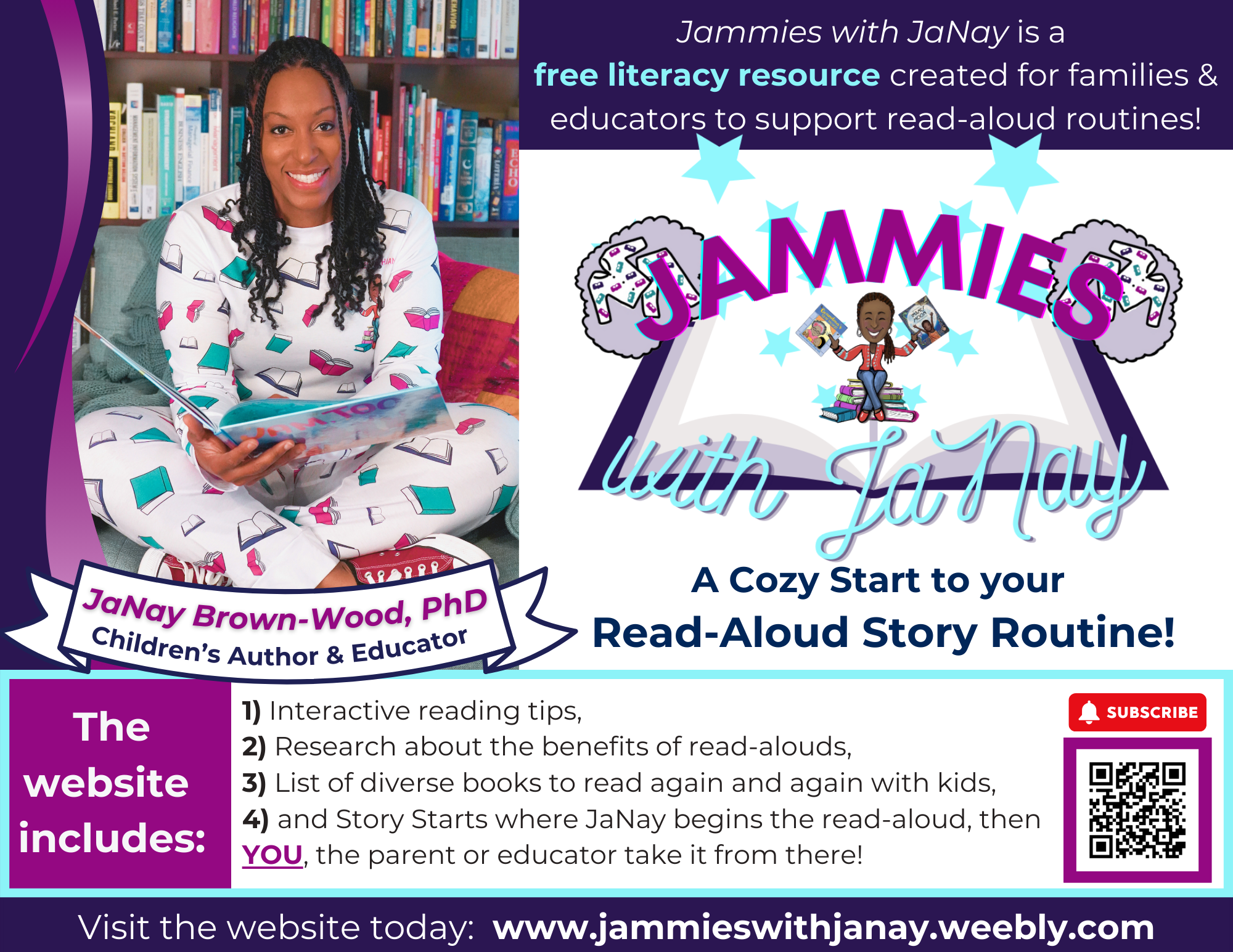
- Establish or reinstate the bedtime story routine: Maybe you used to read to your child when he/she was very young. Pick it back up as your child grows, even if they can read to themselves. Not just that, have them join in on the fun of reading, alternating lines or paragraphs or pages. Throw in some silly character voices as you go! Do this in a fun way, giving them a chance to practice reading aloud. Ask questions as you read. And then, together, recap what you read (allowing for them to exercise their comprehension skills, too). Not only are you practicing reading, speaking, listening, and comprehending—you are doing it during bedtime, sparking happy memories cuddled around a book while encouraging great conversation. Check out my free resource Jammies with JaNay (jammieswithjanay.weebly.com) for some ideas about how to read interactively.
- Come up with shared text: Write stories together but start off by telling them aloud and then writing them down. Reread them together, add pictures, play with elements of story. Do the same with poetry or drama scripts. Even if your child is not able to write yet, dictate (write down) what they say, showing them how language can be captured using symbols that are written down on paper or typed on a screen. Let them “write” some of their own ideas down, and even if it is not actually words, ask them what they say and write the real words down next to their writings so they can see. Make it fun, playful, and memorable.
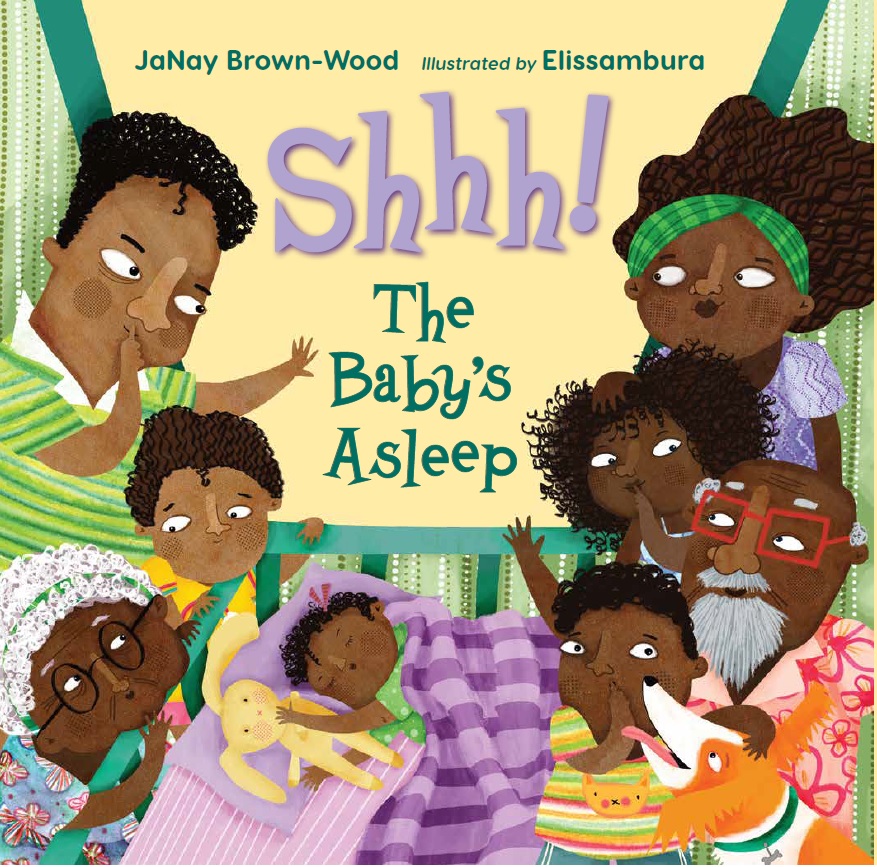
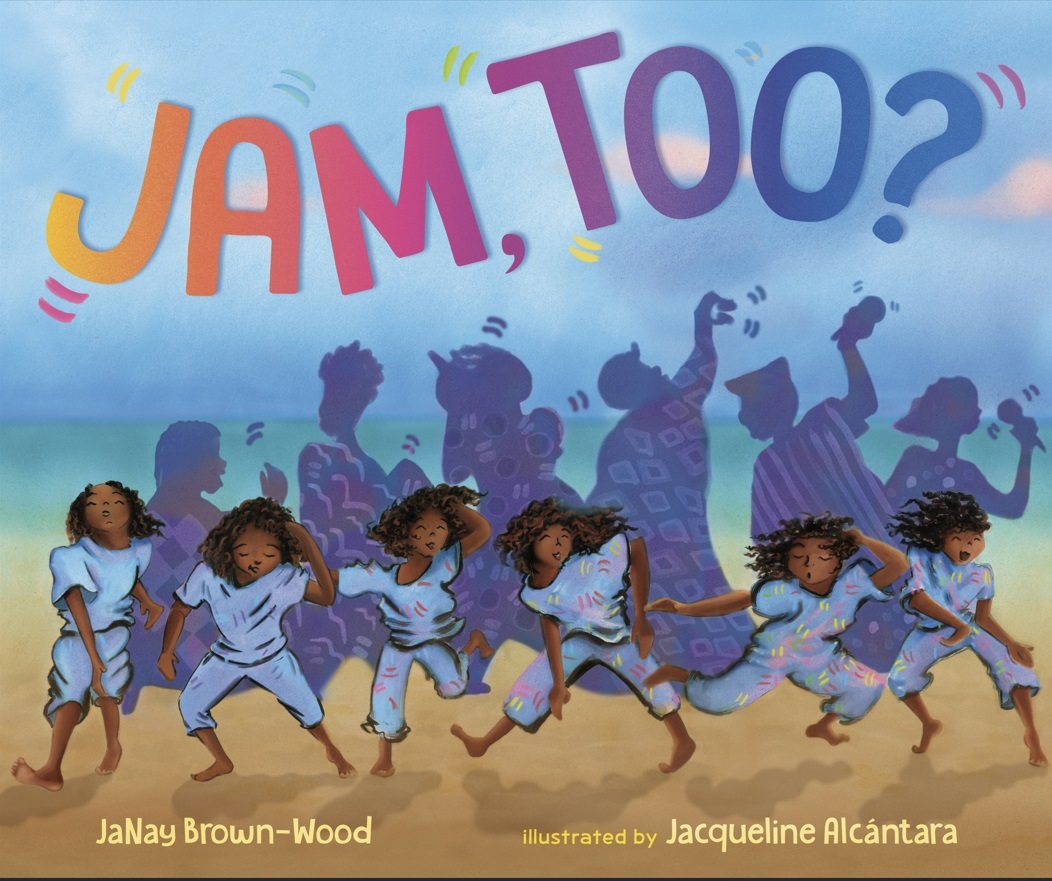
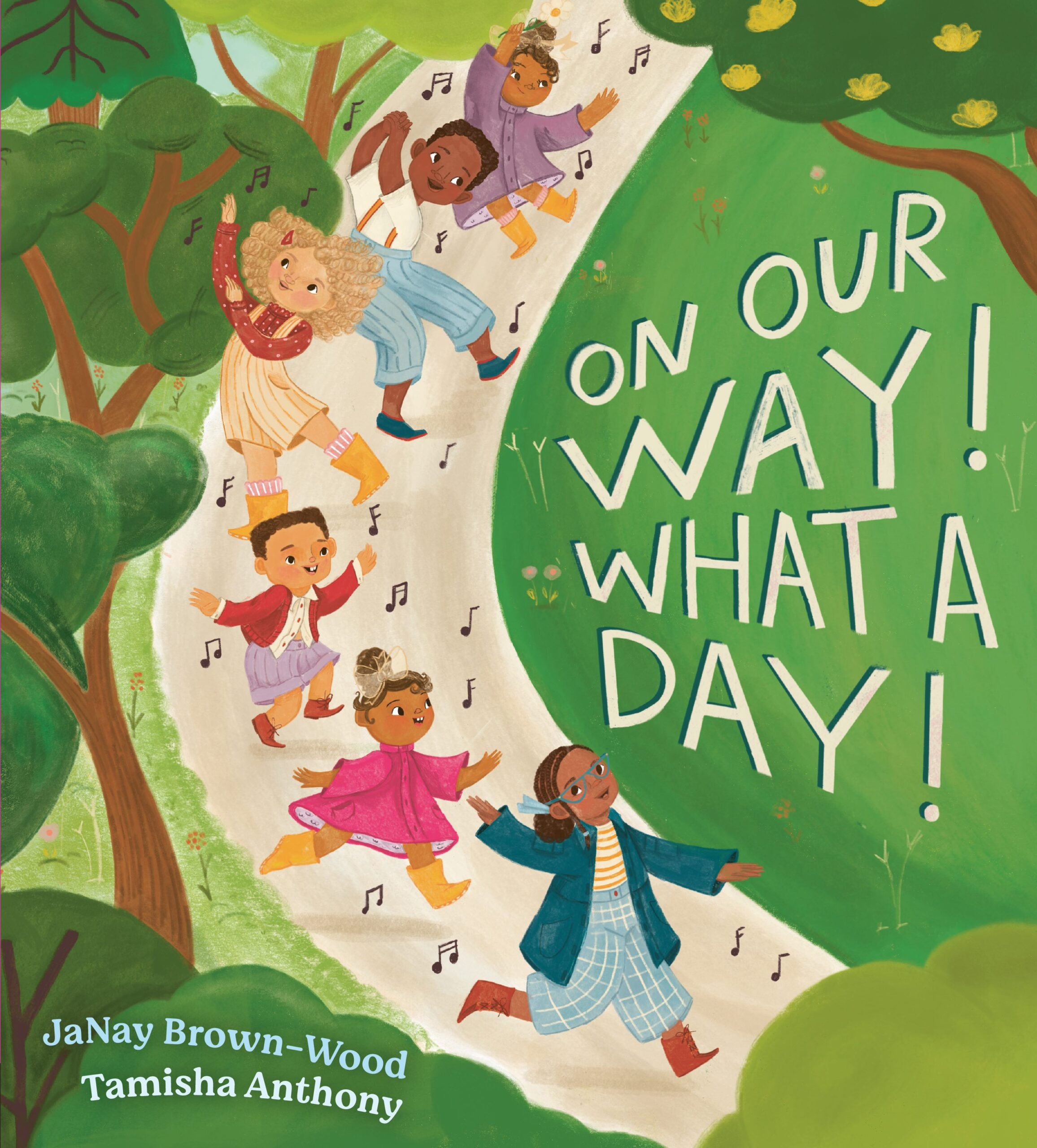
Playful, warm, fun experiences with reading, writing and spelling are important for setting the stage for literacy learning. These early experiences can help children begin to develop needed skills such as the Big Five of Beginning Reading (USA National Reading Panel, 2000) which are all built on oral language skills. Check out some of my books like Jam, Too (Nancy Paulsen Books/Penguin Random House), Shhh! The Baby’s Asleep (Charlesbridge Publishing), and On our Way! What a Day! (Nancy Paulsen Books/Penguin Random House)

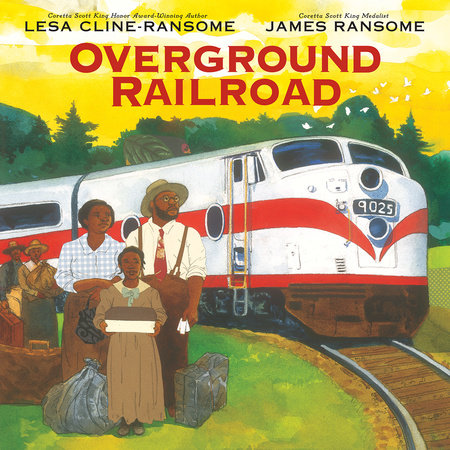
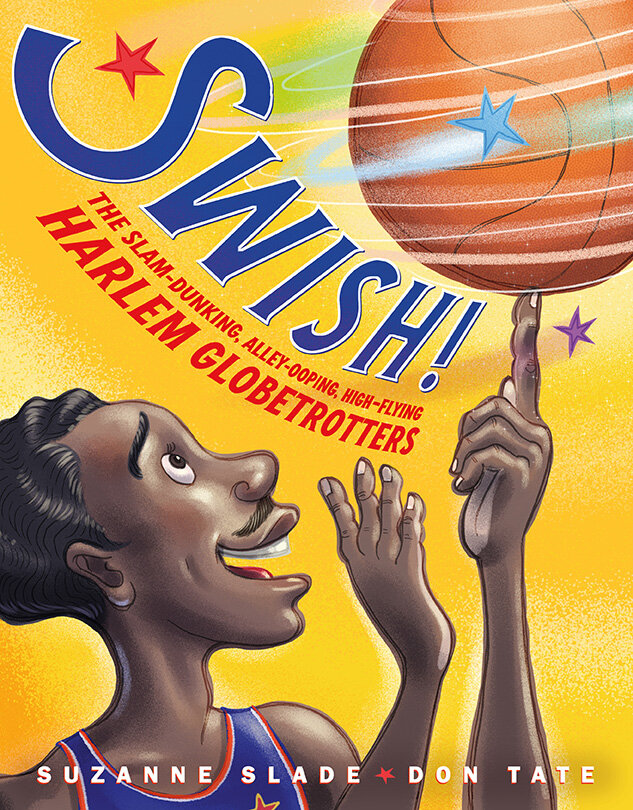
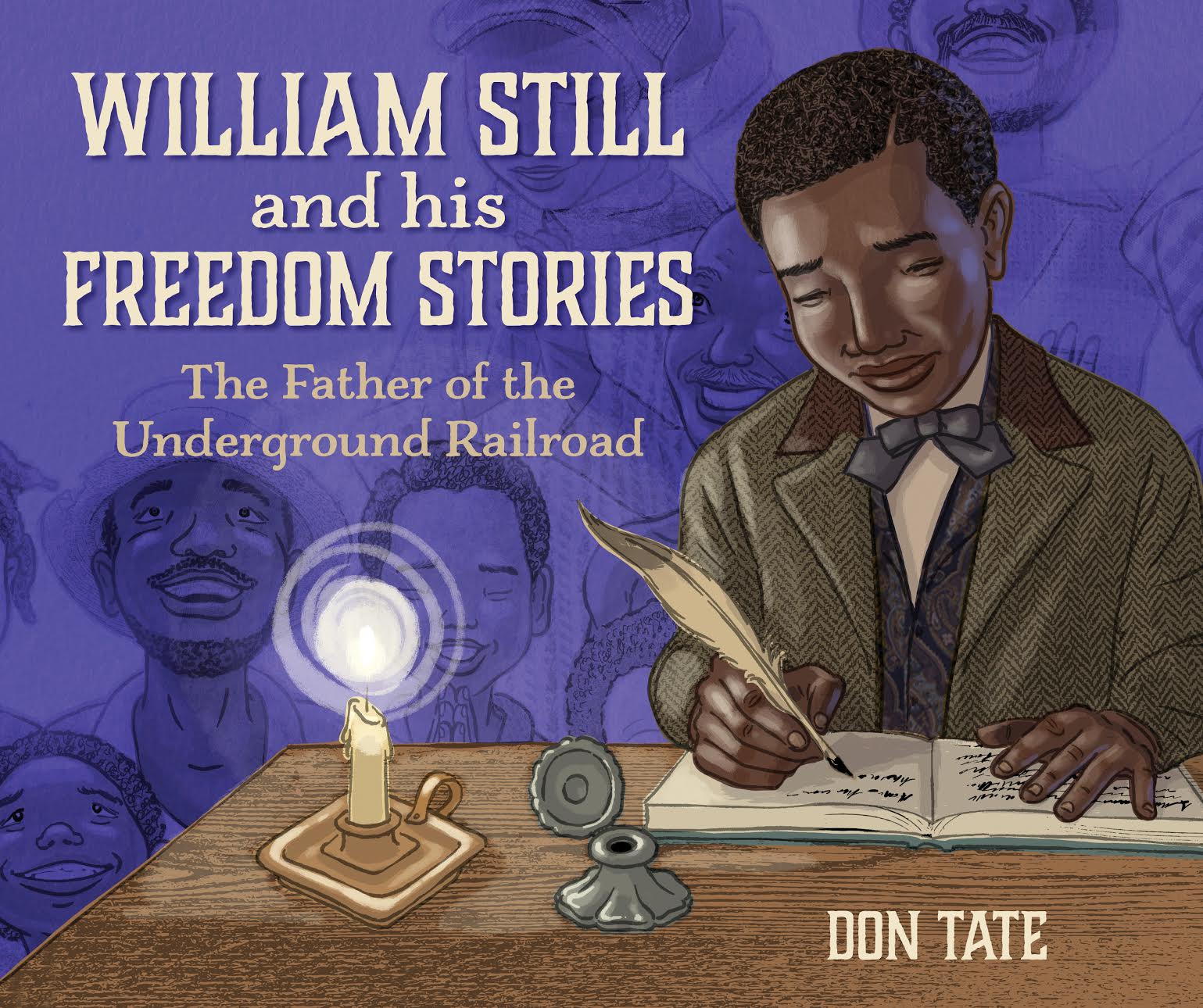 super stoked to have just received the award in the Nonfiction Text for Younger Readers category for his picture book
  This collection of interrelated stories, published by Heartdrum in partnership with

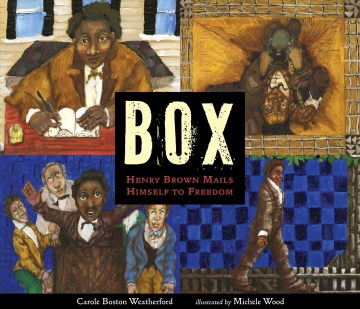 Carole Boston Weatherford claimed a Newbery Honor Award for
 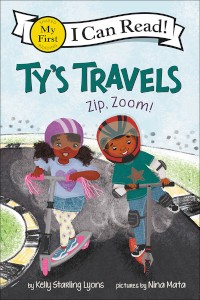 New readers will be reveling in this title! Fantasic job Kelly and illustrator Nina!
 In addition, she has been named the first
 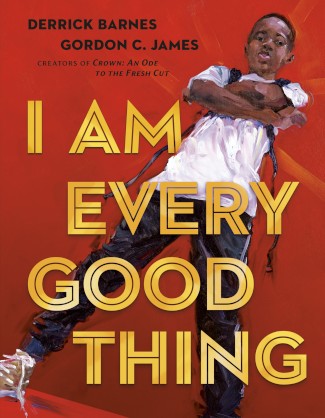 Breaking news! Gordon C. James, illustrator of Derrick Barnes’ picture book I AM EVERY GOOD THING have won the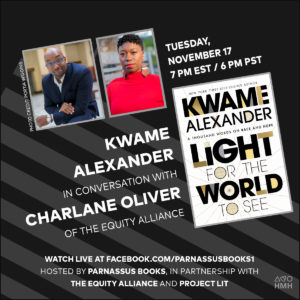
 has two in November with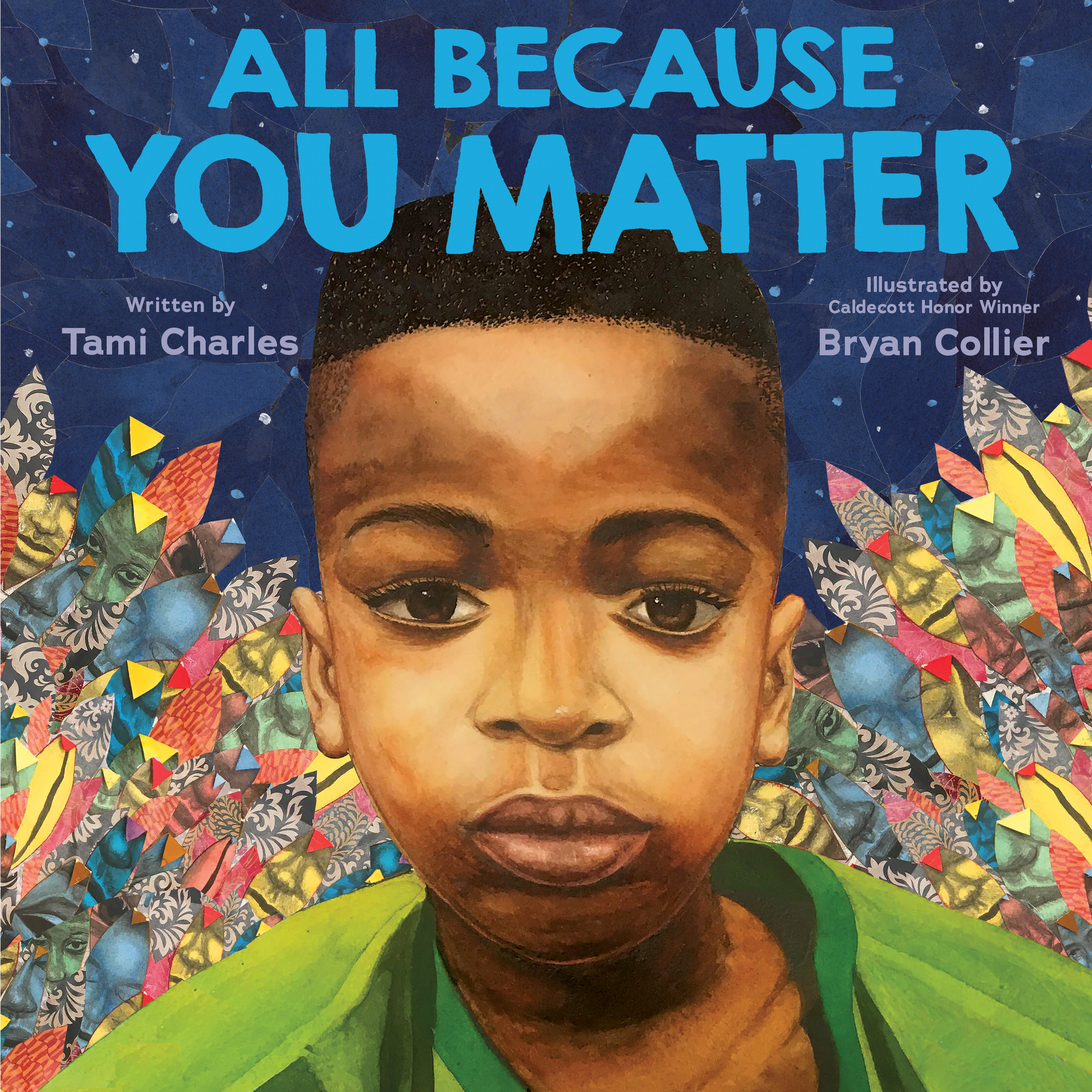
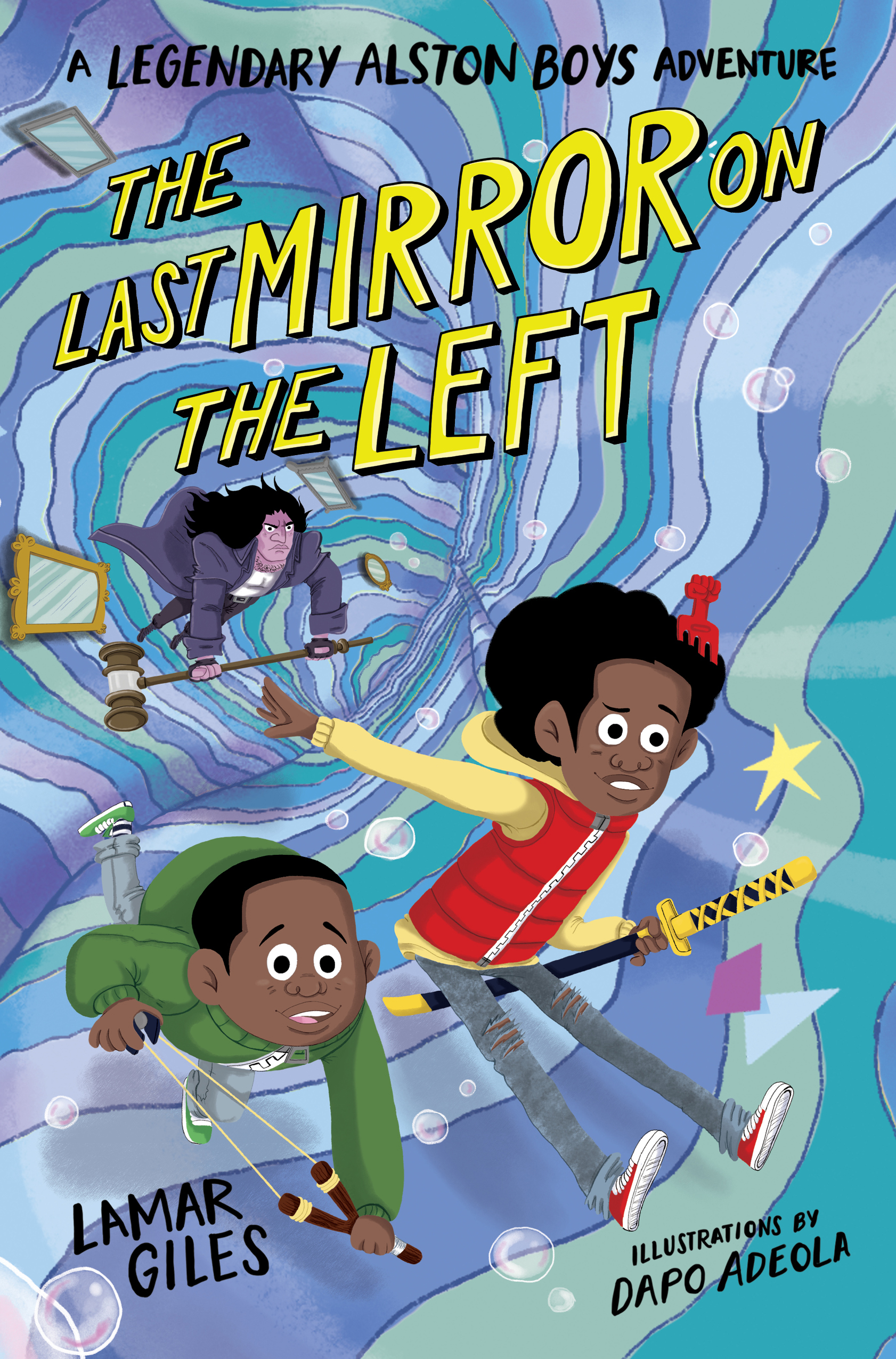 and teen books. Everyone has been waiting for